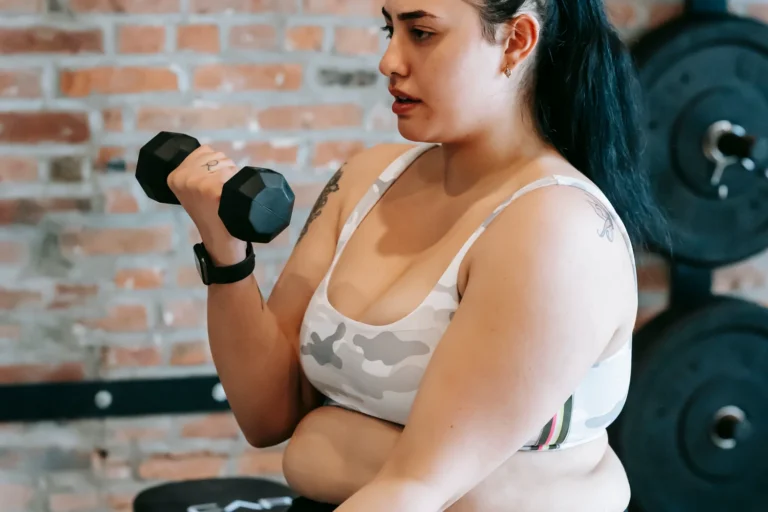
One person tells you to lift as heavy as possible. Another says light weights build the same muscle if you do enough repetitions. Both statements contain a piece of the truth, but neither tells you what to put on the bar when you walk into the gym tonight.
 Product optionEFX Kre-Alkalyn Creatine CapsulesCreatine capsules in a convenient format.Affiliate link · Price and availability may change.Check on Amazon As an Amazon Associate I earn from qualifying purchases.
I recommend choosing a weight that makes the last few repetitions genuinely difficult while your technique remains controlled. That could mean six repetitions on a squat, ten on a chest press or fifteen on a lateral raise. The right weight depends on the exercise, your experience and how close the set comes to the point where another clean repetition is not possible.
Short answer: to build muscle, use a weight that allows roughly 5 to 30 controlled repetitions and leaves about zero to three good repetitions in reserve at the end of a working set. Moderate ranges such as 6 to 15 repetitions are practical for most exercises, but effort, progression and technique matter more than one perfect number.
There is no single muscle-building weight
Research comparing lower and higher loads shows that muscle can grow across a fairly wide range when sets are sufficiently challenging. Heavier loads generally have an advantage for improving one-repetition maximum strength because you practise producing force against heavy resistance. Hypertrophy is less tied to one narrow range.
That does not mean every load is equally convenient. Sets of thirty squats can be limited by breathing, discomfort and concentration before your legs receive the intended challenge. Very heavy sets of two or three demand more setup, rest and technical precision. For ordinary muscle-building programmes, the middle gives a good balance of tension, control and time.
I usually keep compound exercises somewhere around 5 to 12 repetitions and isolation work around 8 to 20, while allowing exceptions. A leg press may feel excellent for fifteen. A lateral raise may be safer and more effective at twenty than at six. The repetition range serves the exercise; the exercise does not have to obey a universal rule.
What “heavy enough” actually feels like
A working set should become noticeably slower and harder near the end. You should still control the lowering phase, keep the intended range of motion and avoid using half your body to move the weight. If you finish ten repetitions and could immediately perform another ten, the set was probably too easy to be an efficient muscle-building set.
I use repetitions in reserve, often shortened to RIR. Three RIR means you believe you could have completed three more clean repetitions. One RIR means perhaps one remained. Zero RIR means you reached the point where another full repetition was not available with acceptable form.
This is an estimate, not a laboratory measurement. Beginners often stop further from failure than they think because the burning sensation is unfamiliar. With practice, you become better at judging it. I do not expect perfect accuracy in week one.
A simple effort guide
- Four or more repetitions left: useful for warm-ups, technique work or recovery, but often too easy for your main working sets.
- Two to three left: challenging, repeatable and a good place for many compound sets.
- One left: hard and productive when technique stays stable.
- No repetitions left: muscular failure; useful selectively, but not required on every set.
I would rather see a controlled set stopped at one or two RIR than a forced repetition where someone changes the movement completely. The target is muscular effort, not simply getting the dumbbell from the bottom to the top by any route available.
Do you need to train to failure?
No. Training close to failure is important, particularly with lighter loads, but reaching absolute failure on every set can create more fatigue than benefit. It can also make technique less reliable on free-weight compound exercises.
For squats, Romanian deadlifts, presses and rows, I commonly keep one to three good repetitions in reserve. On a machine curl, leg extension or lateral raise, taking the final set to failure can be more practical because the consequence of a failed repetition is smaller.
Your whole session matters. If the first set is so hard that performance collapses for the next three exercises, the extra effort may have reduced your total useful work. Productive training is not a competition to look most exhausted.
How to choose your starting weight
Pick the exercise and a target range before loading it. Suppose your programme says three sets of 8 to 12 on a dumbbell press. After warm-up sets, choose a weight you expect to lift for around ten clean repetitions with two or three still available.
Perform the set and use what happened:
- If you reached 12 and could have done five more, increase the weight for the next set.
- If you reached 10 with about two repetitions left, keep it.
- If you struggled to reach eight or technique changed early, reduce it.
- Record the final load, repetitions and estimated effort.
The first session is partly an assessment. You do not need a calculator to predict the exact weight. A few sensible test sets are safer and more specific than copying the load used by somebody with different leverages and experience.
Warm-up sets are not working sets
A warm-up prepares the movement without creating unnecessary fatigue. Start light, practise the range and add load in steps. As you approach the working weight, perform fewer repetitions.
For example, before a heavy leg press, you might use one easy set of ten, a moderate set of five and a heavier set of three before the first working set. The exact number depends on the exercise and how much weight you use. A cable curl may need only one lighter set.
I do not count every warm-up as muscle-building volume. If all five preparation sets are taken close to failure, they are no longer a warm-up; they are extra work that may reduce the quality of the sets you planned.
How to progress the weight
Adding weight is one form of progressive overload, not the only one. You can also complete more repetitions with the same load, improve control, use a fuller comfortable range of motion or perform the same work with better consistency.
A straightforward method is double progression. Choose a range, such as 8 to 12. Keep the same weight until you can reach the upper end on all working sets at the intended effort. Then add the smallest practical amount and allow repetitions to fall towards eight again.
 Product optionWeightWorld Magnesium Complex 4-in-1Magnesium capsules for a simple supplement routine.Affiliate link · Price and availability may change.Check on Amazon As an Amazon Associate I earn from qualifying purchases.
Imagine you use 20 kg dumbbells for 12, 11 and 9 repetitions. Next week you might aim for 12, 11 and 10—not immediately jump to 25 kg. When you eventually achieve 12 across the sets with sound form, move up. Small plates or adjustable dumbbells make this easier, especially on isolation exercises.
Why the same weight feels different from week to week
Performance changes with sleep, food, stress, exercise order and recovery. A load that felt smooth last Tuesday may feel heavy after a poor night or a long shift. That does not mean you lost muscle in seven days.
Use the first working set as information. If the warm-up is unusually slow, keep the load and accept fewer repetitions, or reduce it slightly. Your programme should guide decisions without pretending you are a machine.
Look at progress across four to eight weeks. One excellent or poor session is noise. Repeated improvement in loads, repetitions and execution is the signal.
Choosing weight for different exercises
Compound free-weight movements
Squats, presses, deadlift variations and unsupported rows involve several muscles and require more coordination. I prefer stopping before technique breaks down. A slightly heavier load for moderate repetitions often works well, but only if you can control it.
Machines
Machines provide more stability, so you can often push closer to failure with less concern about balancing the load. They are not a lesser form of training. A stable chest press or leg curl can let you focus on the target muscle and measure progression clearly.
Isolation exercises
Lateral raises, curls, triceps extensions and calf raises usually suit moderate or higher repetitions. If adding one plate turns a lateral raise into a shrug and swing, the extra weight is not progression for the intended muscle.
Bodyweight exercises
Press-ups, pull-ups and dips still use resistance. Progress them by adding repetitions, improving range, slowing control or adding external weight. If a full version is too difficult, assistance or an easier angle lets you train in a useful range.
Technique matters, but it does not need to look robotic
Good technique keeps the movement repeatable and directs work towards the intended muscles. It does not mean every body must use identical foot width, grip or range. Limb lengths, mobility and comfort differ.
I look for control, a stable setup, a range that is comfortable and repeatable, and no sharp pain. The last repetition may move more slowly, but it should still resemble the first. If the range becomes half as long simply to claim a heavier load, compare that as a different exercise.
 Product optionOptimum Nutrition Gold Standard WheyWhey protein powder for a convenient shake.Affiliate link · Price and availability may change.Check on Amazon As an Amazon Associate I earn from qualifying purchases.
Common mistakes I see
Testing strength instead of training it. Max attempts show what you can lift once; they do not need to dominate a muscle-building plan.
Adding weight before earning it. If the current load is still outside the target range, improve it before making the jump.
Stopping as soon as a set burns. A burning sensation can arrive well before the muscle is close to failure, especially on high-repetition work.
Taking every compound set to failure. This can make the rest of the session worse without adding meaningful benefit.
Changing exercises too often. You cannot judge progression when the movement, machine and repetition range change every week.
Comparing machine numbers between gyms. Cable ratios, lever arms and machine designs differ. Compare your performance on the same setup.
What I would focus on first
I would choose a practical repetition range for each exercise and keep the exercise stable for at least six weeks. Record the load, repetitions and a simple RIR estimate. Most working sets should finish within one to three clean repetitions of failure.
Then I would aim to add a repetition somewhere before adding weight. This makes progress visible without forcing large jumps, and it teaches you what a genuinely challenging set feels like.
When lighter weights are the better choice
Use lighter resistance when learning a movement, returning from a break or working around a professionally assessed injury. It can also make sense when heavy joint loading feels uncomfortable but higher repetitions are pain-free.
Sharp pain, sudden weakness, numbness or pain that keeps worsening is not a cue to find a tougher mindset. Stop the movement and seek advice from a GP, physiotherapist or other suitable clinician. General loading advice cannot diagnose an injury.
Frequently asked questions
Is lifting heavy necessary for muscle growth?
No. Muscle can grow with lighter and heavier loads when sets are challenging. Heavier lifting is more specific to developing maximal strength.
Is 8 to 12 repetitions best for building muscle?
It is a useful and efficient range, not a magic one. Lower and higher repetitions can also build muscle when the load, effort and exercise are appropriate.
How do I know if a weight is too light?
If you reach the top of the range with several clean repetitions still available, it is probably too light for that working set. Add a small amount or perform more repetitions.
How often should I increase the weight?
Increase it when you can complete the top of your planned range across the required sets with good technique and the intended effort. There is no need to force weekly jumps.
Should beginners train to failure?
Beginners can make excellent progress without regular failure training. Learning stable technique and gradually understanding effort should come first.
Can high repetitions build muscle?
Yes, within a practical range and when the set gets close enough to failure. Very high repetitions may be limited by discomfort or cardiovascular fatigue rather than the target muscle.
Your next workout
Choose one exercise and give it a clear range, such as 8 to 12. Use a load that leaves about two clean repetitions on the first working set, record the result and try to improve one repetition next time. That simple process tells you far more than chasing the heaviest dumbbell in the room.
If you want a programme with the exercises, ranges and progression rules matched to your experience and available equipment, that is exactly what I help SykerFlex coaching clients with. The goal is not to lift heavy for the sake of it; it is to make each set useful.
Sources and further reading
- Low- versus high-load resistance training: systematic review and meta-analysis
- Resistance training load effects on muscle hypertrophy and strength
- Training to repetition failure versus non-failure: systematic review and meta-analysis
Training coaching
Turn useful advice into your own programme.
I can structure your sessions around your experience, available equipment, schedule and progress.
About the author
Roland Balogh
I’m an Active IQ Level 3 Personal Trainer, qualified in nutrition for sport and exercise performance. I help people build strength, improve their nutrition and stay consistent—without extreme plans or living in the gym.- Level 3 Personal Trainer
- Sport & Exercise Nutrition
- Mental Health Awareness
Keep reading
Related articles