
Walk into any commercial gym in the world, and you will see the same regulars. They are there every Monday at 6 PM, hitting the chest press, doing their curls, and chatting by the water cooler. They are consistent, they work hard, and they sweat.
Yet, if you look closely, you will notice something terrifying: they look exactly the same today as they did three years ago.
Why does this happen? They aren’t lazy. They aren’t eating junk. The problem is that they are ignoring the fundamental law of human physiology. They are doing the same workout, with the same weight, for the same reps, week after week.
To build muscle and gain strength, you must force your body to adapt to a stress it hasn’t encountered before. This principle is called Progressive Overload. Without it, you are not training; you are just exercising.
In this guide, I’m going to demystify progressive overload, show you that it is about much more than just “adding weight,” and give you real-world examples you can use in your next session.
The Biology of “Getting Big”
Your body does not want to build muscle. Muscle is expensive tissue; it requires a lot of energy (calories) to keep alive. From an evolutionary standpoint, your body prefers to be efficient.
When you lift weights, you are sending a stress signal to your body. You are essentially telling it: “This environment is difficult. We need to get stronger to survive.” Your body responds by building thicker muscle fibers to handle that stress next time.
However, once your body has adapted to lifting 50kg, that weight is no longer a “stress.” It becomes the new normal. If you keep lifting 50kg, your body has no reason to grow further. To restart the growth process, you must increase the demand. You must overload the system.

If you aren’t tracking it, you can’t improve it.
The 4 Pillars of Progression
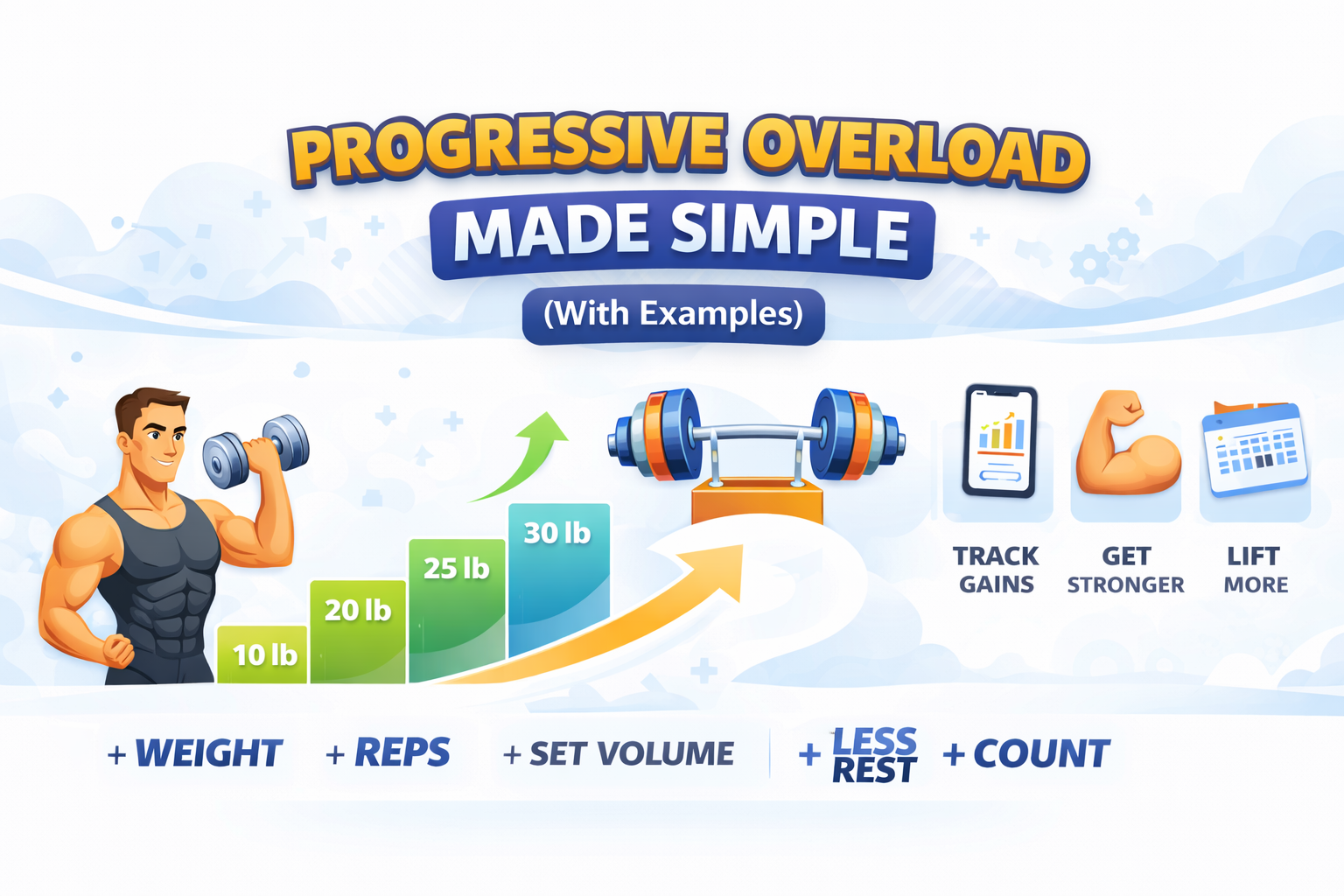
Most beginners think progressive overload simply means adding 2.5kg to the bar every week. While that is one method, it is not sustainable forever. Eventually, you would be bench pressing a truck. When you hit a plateau in weight, you must manipulate other variables. Here are the four main levers you can pull:
1. Increase Intensity (Load)
This is the classic method. If you squatted 60kg last week, you squat 62.5kg this week. This is most effective for beginners (Linear Progression), but as you get advanced, these jumps become harder to sustain.
2. Increase Volume (Reps)
If you cannot add weight, add reps. If you benched 80kg for 3 sets of 8 last week, try to hit 3 sets of 9 or 10 this week with the same weight. You are still doing more total work, which forces adaptation.
3. Improve Technique (Efficiency)
This is the “silent” progression. If you lifted 100kg last week but your form was shaky and you bounced the bar off your chest, and this week you lift 100kg with perfect control and a pause at the bottom, you have gotten stronger. You placed more tension on the target muscle and less on your joints.
4. Reduce Rest (Density)
If you usually rest 3 minutes between sets, try resting 2 minutes. Doing the same amount of work in less time increases “metabolic stress,” which is a potent driver of hypertrophy (muscle growth).
Real-World Example: A 4-Week Progression
Let’s look at how I might program the Dumbbell Shoulder Press for a client over a month. Notice how we don’t just blindly add weight every session.
- Week 1 (Baseline): 20kg Dumbbells × 3 sets of 8 reps. (Felt hard, RPE 8).
- Week 2 (Volume): 20kg Dumbbells × 3 sets of 10 reps. (We kept the weight the same but pushed for more reps).
- Week 3 (Volume): 20kg Dumbbells × 3 sets of 12 reps. (Maxed out the rep range).
- Week 4 (Load): 22kg Dumbbells × 3 sets of 8 reps. (We increased weight, so we dropped the reps back down to restart the cycle).
This is called Double Progression. You master a weight across a rep range (e.g., 8–12), and only once you hit the top end of that range do you earn the right to add weight.
The Tool You Cannot Ignore: The Logbook
You cannot manage what you do not measure. I cannot stress this enough: You must log your workouts.
Whether you use an app or a physical notebook, you need to walk into the gym knowing exactly what numbers you need to beat. If you are guessing, you are leaving gains on the table. Before you start your first set of squats, you should look at your phone and say, “Okay, last week I got 100kg for 8. Today, I need 100kg for 9, or 102.5kg for 8.” That specific target gives you the psychological edge to push harder.

Stop “Exercising” and Start Training
Progressive overload is simple, but it isn’t easy. It requires showing up when you are tired. It requires grinding out that extra rep when your lungs are burning. It requires leaving your ego at the door and focusing on perfect form rather than just moving weight from A to B.
But this is the difference between the person who spins their wheels for years and the person who transforms their physique in months. One is exercising; the other is training.
If you are ready to stop guessing and want a structured plan that handles all the math and progression for you, check out my deployment options below. I’ll give you the numbers; you just have to do the work.
Deployment Options
| Protocol | Specifications | Investment |
|---|---|---|
| LITE Accountability |
• Custom Training Plan (Home/Gym) • Basic Calorie + Protein Targets • Bi-weekly Check-in • WhatsApp Support (24-48h) |
£59/mo |
| STANDARD RECOMMENDED |
• Full Nutrition Plan • Weekly Check-ins • Video Form Analysis • WhatsApp Support (Mon-Fri) |
£89/mo |
| PREMIUM Max Contact |
• Everything in Standard • Weekly Video Check-in Call • High-Frequency Tweaks • Priority WhatsApp |
£119/mo |
