Push-up progression for chest and core is one of the most useful bodyweight systems because it trains pressing strength, trunk stability and shoulder control at the same time.
Push-Up Progression for Chest and Core: Why It Works
The push-up is often treated as a basic exercise, but it can be scaled from complete beginner to advanced. The key is choosing the right variation for your current strength level. If the variation is too hard, form collapses. If it is too easy, progress stalls.
A good push-up trains more than the chest. It also works triceps, shoulders, serratus anterior, abs, glutes and body tension. This makes it a strong exercise for home workouts, travel workouts and general strength building.
Perfect Push-Up Setup
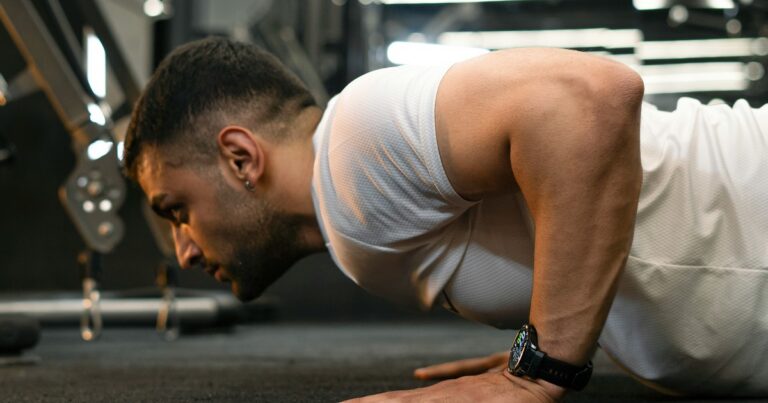
Place hands slightly wider than shoulder width. Spread the fingers and screw the hands lightly into the floor. Keep the ribs down, glutes lightly squeezed and body in a straight line. Lower with control and keep elbows around 30 to 60 degrees from the body rather than flaring straight out.
At the bottom, the chest should move toward the floor without the hips sagging. Push the floor away and finish strong at the top. Do not let the head poke forward or shoulders collapse.
Beginner Push-Up Progression
Start with incline push-ups using a bench, table or sturdy surface. The higher the surface, the easier the push-up. When you can complete 3 sets of 10 to 15 reps with good control, lower the height.
Next, move to knee push-ups only if they help you practise control. For many people, incline push-ups are better because they keep the body line closer to the full push-up position.
Intermediate Push-Up Progression
Once floor push-ups are strong, use tempo. Lower for three seconds, pause briefly near the bottom, then press up. Tempo makes lighter bodyweight work feel harder and improves control.
You can also use paused push-ups, deficit push-ups, close-grip push-ups or feet-elevated push-ups. Choose one progression at a time. Do not add every variation at once.
Push-Up Workout Plan
- Incline or floor push-up: 4 sets of 8 to 12 reps.
- Tempo push-up: 3 sets of 6 to 8 reps.
- Plank shoulder tap: 3 sets of 8 each side.
- Close-grip push-up or bench dip: 2 to 3 sets of 8 to 12 reps.
- Dead bug: 3 sets of 8 each side.
Common Push-Up Mistakes
The first mistake is sagging at the hips. This turns the exercise into lower-back extension instead of a strong pressing movement. The second is flaring elbows too wide, which can irritate shoulders. The third is cutting range short and counting partial reps as progress.
Quality matters. A clean set of eight strong push-ups is better than twenty rushed reps with poor position.
Internal Exercise Links
Balance your pressing with dumbbell rows for back growth. If your shoulders feel stiff before push-ups, use the mobility routine for hips and shoulders.
Push-Up Progression For Chest And Core FAQ
What is the best push-up progression for beginners?
Start with incline push-ups, then lower the height over time. Once floor push-ups are controlled, progress to tempo, paused and deficit variations.
Why do push-ups hurt my wrists?
Wrist discomfort can come from poor hand position, limited wrist mobility or too much volume too soon. Handles or dumbbells can create a more neutral wrist position.
Are push-ups good for building chest?
Push-ups can build chest muscle when sets are challenging, technique is controlled and progression is used over time.
How many push-ups should I do per workout?
Most people progress better with 3 to 5 challenging sets rather than endless low-quality reps.
Need a Simple Training Plan?
Need a simple training plan? Book a free SykerFlex consultation.
Training coaching
Turn useful advice into your own programme.
I can structure your sessions around your experience, available equipment, schedule and progress.
About the author
Roland Balogh
I’m an Active IQ Level 3 Personal Trainer, qualified in nutrition for sport and exercise performance. I help people build strength, improve their nutrition and stay consistent—without extreme plans or living in the gym.- Level 3 Personal Trainer
- Sport & Exercise Nutrition
- Mental Health Awareness
Keep reading
Related articles